
LiFePO4 Battery 25.6V vs 51.2V: Sizing the Right Storage Pack for Your Market
The voltage question is really a current question
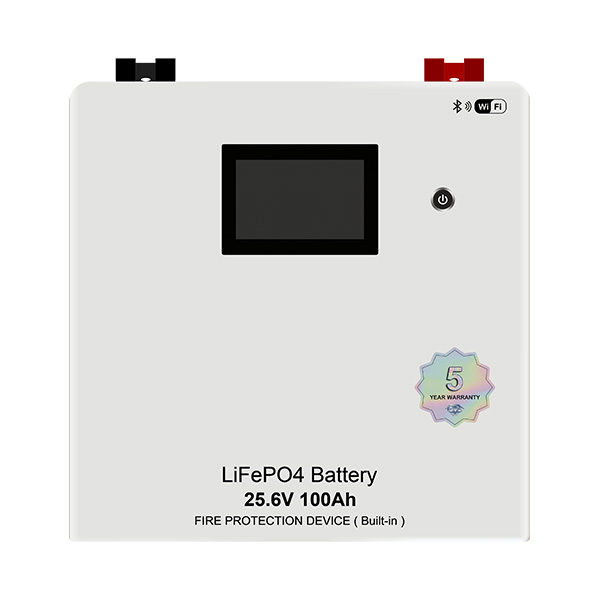
A LiFePO4 cell has a nominal 3.2 volts. String eight in series and you get 25.6 volts, which is the standard low-voltage pack. String sixteen and you get 51.2 volts, the standard high-voltage pack. Quanshi builds both: 25.6V units at 100 Ah and 200 Ah in wall-mounted form, and 51.2V units at 200 Ah, 314 Ah, 600 Ah and 628 Ah in rack-mounted form.
Why does that matter to a buyer? Because power equals voltage times current. At the same power draw, a 25.6V pack pulls twice the current of a 51.2V pack. Twice the current means thicker cables, larger terminals, more heat at every connection, and a BMS and inverter rated for higher amps. Below about 5 kW of continuous power, low voltage is perfectly manageable. Above it, the hardware cost of handling the current starts to erode the savings.
Where 25.6V wall-mounted packs win
Residential backup and small off-grid systems are the natural home of the 25.6V pack. A 25.6V 100 Ah unit stores roughly 2.56 kWh, and the 200 Ah version about 5.12 kWh. That is the right scale for an apartment, a small house, a shop, a telecom shelter or a remote monitoring station.
The installation advantages are real. Wall mounting keeps the floor clear and gets the pack off a potentially damp slab. Lower voltage is friendlier for installers working in markets where high-voltage DC certification is expensive or uncommon. And the pack matches the input window of the smaller hybrid inverters in the Quanshi range, which start at 1.2 kW and run through 3.6 kW and 6.5 kW in single-phase.
Where 51.2V rack-mounted packs win
Once you pass roughly 10 kWh of storage, the 51.2V architecture becomes hard to argue against. A 51.2V 314 Ah pack stores around 16 kWh. The 600 Ah and 628 Ah versions reach roughly 30 kWh and 32 kWh respectively. At that scale, racks stack in a cabinet, cabling stays sane, and the current stays within what a reasonably sized BMS and inverter handle comfortably.
Commercial and industrial applications, such as peak shaving for a factory, backup for a cold chain facility, or a solar-plus-storage installation at a school or clinic, almost always land here. These are also the projects where three-phase hybrid inverters in the 10 kW to 50 kW band come into play, and those inverters expect a high-voltage DC bus.
Both architectures at Quanshi ship with the fire protection device built in, which is worth its own discussion when the pack is going into an occupied building.
A worked sizing example
A small factory wants to shave its peak demand and carry critical loads through short grid outages. Critical load is 12 kW, and the requirement is four hours of coverage.
Storage needed is 12 kW times 4 hours, which is 48 kWh. LiFePO4 is routinely cycled to 80 percent depth of discharge for daily cycling, so divide by 0.8 and the required nameplate capacity is 60 kWh. Two 51.2V 600 Ah packs store roughly 61 kWh, so two units meet the requirement with a little margin. At 25.6V, the same capacity would need roughly twelve 200 Ah wall packs, along with a busbar arrangement and cabling that no installer would recommend.
That comparison is the whole argument. The low-voltage pack is not worse, it is simply built for a different scale of problem.
Matching the pack to the inverter
Battery voltage must sit inside the inverter's DC input window, and the BMS must speak the same protocol as the inverter. Quanshi's BMS supports CAN, RS485 and Modbus, and customer-defined parameters can be pre-flashed on ODM orders. That last point matters more than it sounds: mismatched communication is the single most common reason a storage system fails to commission on schedule, and it is entirely avoidable if the protocol is specified in the purchase order.
What to send when you enquire
Give the daily energy consumption in kWh, the peak load in kW, the number of backup hours required, the inverter brand and model already on site, whether the system is single-phase or three-phase, and the ambient temperature range. With that, the correct configuration is usually a matter of arithmetic, and Quanshi's team will return a feasibility quote with the matching inverter and rack.