
Dry-Type vs Oil-Immersed Transformer: Which One Does Your Project Actually Need?
Start with the room, not the datasheet
Most transformer selection arguments go in circles because they start with efficiency tables. The decision is usually already made by the place the unit has to live. If the transformer goes inside a building that people occupy, cast resin wins before you compare a single watt of loss. If it goes in an outdoor substation or on a pole, oil-immersed is the conventional and usually cheaper answer.
Quanshi manufactures both lines in the same 30 kVA to 2,500 kVA range with primary voltages up to 35 kV, which means you can hold the electrical specification constant and choose on installation grounds alone.
Fire behaviour is the first filter
An oil-immersed transformer contains hundreds of litres of insulating liquid. Modern liquids are far less flammable than the askarel fluids of decades past, but they will still burn if they are released as a mist or pool at a fault. That is why oil units come with bunding, drainage, fire-rated separation, and in some jurisdictions suppression systems. Those are real costs that belong in the comparison, not in someone else's budget line.
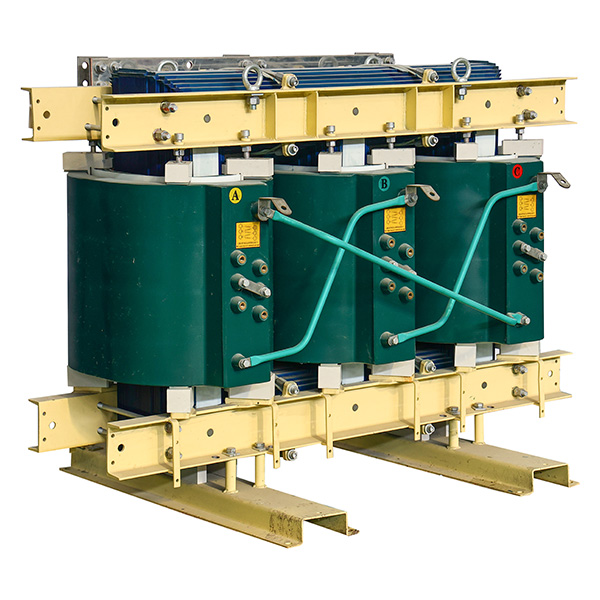
A cast-resin dry-type transformer contains no liquid. The epoxy encapsulation is self-extinguishing, which is why fire officers and insurers routinely require it in high-rise buildings, hospitals, tunnels, underground car parks, data centres and anywhere the transformer shares air with occupants. If you have ever tried to get an oil-filled unit approved for a basement plant room in a commercial tower, you already know how this conversation ends.
Size, cooling and the derating nobody budgets for
Oil moves heat better than air. A dry-type transformer of a given rating is physically larger and heavier for the same duty, and it depends entirely on airflow through its cooling ducts. Put it in a small room with a single door and no louvres and it will run hot, trip on its thermal protection, and get blamed for a ventilation design error.
Oil-immersed units are more forgiving. The tank surface does much of the heat rejection, sealed designs need minimal attention, and outdoor installations get free cooling from ambient air. The penalty is the periodic oil testing regime: sampling, dissolved gas analysis and moisture checks that a dry-type unit simply does not require. Over a twenty-year life, that maintenance programme has a cost, and a responsible specifier should count it.
What it costs, honestly
On capital cost at the same rating, oil-immersed is generally cheaper. On installed cost, the gap narrows once you add the civil works that oil demands: bund, drainage, fire separation, and the space to achieve it. On lifetime cost, the answer depends on duty. A continuously energized indoor unit favours cast resin because you avoid the fire engineering and the maintenance regime. A lightly loaded outdoor unit favours oil because the efficiency and cooling advantages show up over decades.
Noise is another quiet differentiator. Quanshi's cast resin units run below 55 dB at full load, and the epoxy encapsulation damps the core magnetostriction hum that radiates from a steel tank. In a building where the plant room shares a wall with occupied space, the acoustic difference is not a footnote.
When oil still makes sense
Rural distribution, utility substations, temporary construction supplies, mining sites, and any application where the unit will sit outdoors behind a fence with space around it. Oil-immersed also handles overload and short-term emergency duty with more headroom, and the sealed designs tolerate harsh ambient conditions that would foul a ventilated resin winding.
Quanshi's S11 and S13 oil-immersed series cover the same 30 kVA to 2,500 kVA band as the dry-type range, built to IEC 60076 with CE and CCC available and UL or KC on request for markets that require local approval.
A decision checklist you can actually use
Work through these in order and the answer usually appears by the third question. Is the installation indoors and occupied? If yes, choose cast resin. Is there a fire officer, insurer or local code with a view on combustible liquid? If yes, choose cast resin. Is the site outdoors with adequate space and clearance? If yes, oil-immersed is likely the better value. Is the ambient environment dusty, salty or humid? If yes, and the unit must be outdoors, discuss enclosure rating and filtration for either technology. Is capital budget the binding constraint with no fire constraint? Then oil-immersed is usually cheaper.
Send the answers along with rating, voltages, vector group, frequency, impedance and altitude, and the Quanshi engineering team will return a feasibility quote and a delivery schedule.